Zodiac & Myth
The Lion Before Hercules: Leo From Babylon to Nemea
The deep myth of Leo: Babylon's Great Lion in MUL.APIN, the Nemean beast Hercules strangled and skinned, and how one lion travelled from Sumer to Nemea.
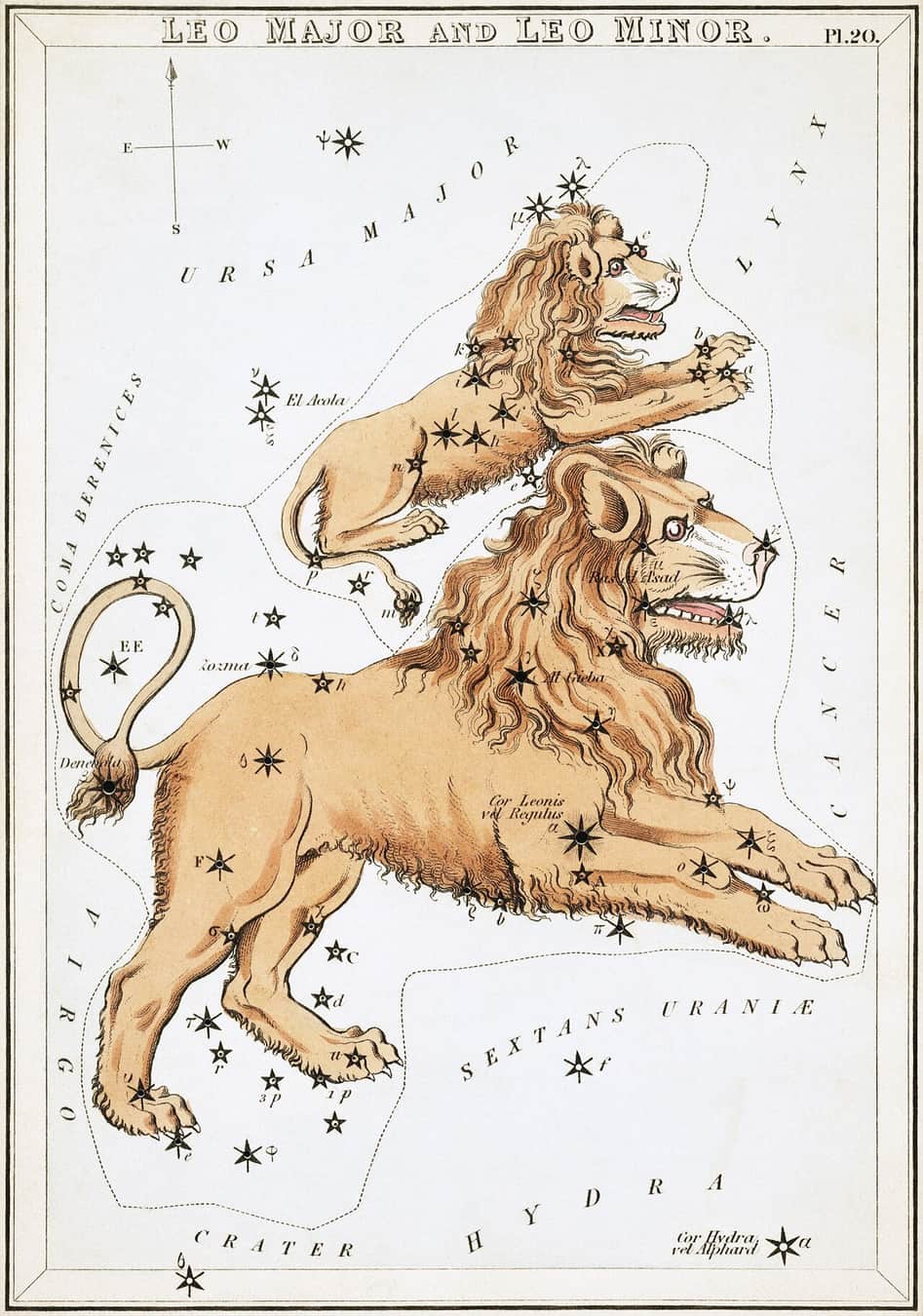
Every zodiac sign is really two things wearing one name: a slice of the calendar and a story about a picture in the sky. For Leo the calendar part is simple enough, and our companion piece on Leo’s dates, traits, and mythology lays out the July-to-August arc and what “born on the cusp” actually means. This essay is about the other half, the older and stranger half. It follows one animal, the lion, from the clay tablets of Mesopotamia to a cave in the hills of the Argolid, and finally up onto the shoulders of a Greek hero and into the stars. It is a genuine piece of transmission history, and almost none of it appears on a horoscope page.
A lion nobody had to translate
Start with a fact that is easy to skip past: the Greeks did not invent the celestial lion. They inherited it. On the Babylonian star lists the constellation is UR.GU.LA, “the Great Lion,” and it is recorded in MUL.APIN, the Mesopotamian compendium of sky lore that gathered up observations far older than the classical Greek astronomers who came later. The abbreviated Sumerian form was simpler still, just UR or UR.A. There is even archaeological argument that a lion figure was read into this patch of sky as early as the fourth millennium BCE, which would make it one of the oldest surviving images humans ever hung on the stars.
What makes this lineage remarkable is not that a lion existed in Babylon. It is that the lion survived the journey intact. Many constellations were quietly rewritten as they passed from one culture to the next. The Babylonians saw a farm labourer in the stars we call Aries, the “Hired Man,” and only later hands turned him into a ram. Leo needed no such editing. The Mesopotamians saw a lion, the Greeks saw a lion, the Romans saw a lion, and the same lion looks down today. When you can trace a single image running unbroken across three thousand years and three civilisations, you are looking at something close to a cultural fossil.
The heart of the beast was marked from the start. The bright star we now call Regulus was known in Babylon as “the star that stands at the Lion’s breast,” and it carried royal weight there long before Rome ever named it the little king. The lion of the sky was a king’s animal from its earliest recorded appearance, and the kingliness sat, quite literally, at its heart.
The lion and the turning of the year
There is a reason a lion, of all animals, ended up guarding high summer. Two things line up here, one astronomical and one agricultural, and it is worth being precise about both because popular pages tend to blur them.
The astronomical fact first. Because of precession, the slow wobble of Earth’s axis that drags the solstice and equinox points around the sky roughly once every twenty-six thousand years, the Sun did not always mark midsummer where it does now. In the third millennium BCE the summer solstice Sun stood squarely within the stars of the constellation Leo. The lion, in other words, once held the very top of the solar year, the hottest, brightest, most commanding position the Sun ever reaches. It is hard to imagine a better fit of image to season: the fiercest animal of the ancient imagination stationed at the fiercest point of the calendar.
The agricultural association is where caution is owed. It is often said that Egypt tied the lion to the annual flooding of the Nile, since the river rose in high summer while the Sun sat among these stars. The flood itself was heralded by the heliacal rising of Sirius, the “dog star,” a relationship so reliable it anchored the Egyptian year for nearly three thousand years. Whether the Egyptians specifically saw a constellation lion here is genuinely disputed: serious scholarship has found little firm evidence that they read Leo the way Babylon did, and the lion-and-Nile link is better treated as a later, popular gloss than as documented Egyptian astronomy. What is solid is the Mesopotamian record and the plain positional fact that the solstice once fell in Leo. Keep those two, and hold the Nile story loosely.
Nemea: the beast in the cave
Now the Greeks, and the story they wrapped around the lion they had received. It is the first of the twelve labours of Heracles, and it is one of the oldest.
The Nemean Lion terrorised the hills around Nemea in the northeastern Peloponnese. Its parentage is told several ways, which is itself a sign of an old and much-handled myth: Hesiod makes it the offspring of the monstrous Orthrus, Apollodorus traces it to Typhon, and a stranger tradition has it fall to earth from the Moon, cast down by the goddess Selene at Hera’s bidding. The versions disagree because the beast was famous enough to attract more than one genealogy. What they agree on is the thing that matters: its golden hide could not be pierced. No arrow, no bronze blade, no spear would cut it. Its own claws were said to be sharper than any sword a man could carry.
King Eurystheus, to whom Heracles was bound in servitude, set the lion as the first task, expecting it to be the last. Heracles found the arrows glancing off the animal’s flank and threw his bow aside. In the older tellings he stunned it with his club, drove it back into its double-mouthed cave, blocked one entrance, and went in after it through the other. There, in the dark, he got his arms around its neck and strangled it with his bare hands. Strength against invulnerability, and strength won.
Then the quieter, cleverer detail that the myth is really proud of. Heracles could not skin the lion, because nothing would cut the hide, until, in the version Athena is said to have prompted, he used one of the lion’s own claws to open it. The only thing that could pierce the pelt was the beast itself. He took the skin and wore it, the great head pulled over his own like a helmet, the impervious hide now his armour. From that point on the lion-skin is Heracles’ signature in art: if you see a Greek hero draped in a lion, you are almost always looking at him.
There is a humane grace note often folded in as well. On his way to the hunt Heracles lodged with a poor labourer named Molorchus, whose own son the lion had killed. The two struck a wager over thirty days, and when Heracles returned victorious the sacrifice that might have mourned him honoured Zeus instead. It is a small human frame around a monster story, and it is very old.
From the cave to the catasterism
The step that turns a labour into a constellation is called catasterism, the placing of a mortal or a beast among the stars. In the Greek scheme it is Zeus who sets the Nemean Lion in the sky, so that the animal Heracles killed becomes the constellation Leo, a permanent trophy and a warning both at once.
We know the story in this astronomical form from named ancient sources, which is worth stressing on a site that cares about where claims come from. The tradition is preserved in the Catasterismi, the collection of star-myths that comes down under the name of Eratosthenes, the third-century BCE scholar who ran the library at Alexandria, and it is set out again in the Astronomica attributed to Hyginus, writing in Latin a few centuries later. These are the texts that explicitly identify the sky-lion as the Nemean beast slain unarmed by Heracles. When Ptolemy fixed the constellation in his second-century Almagest, the lion he catalogued was already carrying all of this freight.
So the Greek contribution is now clear, and it is not the lion. The lion was Babylon’s. What Greece added was a meaning: invulnerability overcome by bare strength, and the skin of a defeated monster turned into a hero’s protection. The Mesopotamians gave the sky its lion and crowned its heart with a king-star. The Greeks gave that lion a death, a killer, and a moral. Rome inherited both and passed them on to us joined at the seam, which is why a modern reader meets “Leo” as a single idea and rarely suspects it was assembled from parts made a thousand years and a thousand miles apart.
Why the deep story is the good story
It is fashionable to treat zodiac signs as personality tags, and the popular Leo, all confidence and mane-tossing showmanship, is a thin thing next to this. The richer inheritance is the one traced above: a lion that outlasted the empires that drew it, a star that meant “king” in an unbroken line from Babylon to the almanac on your phone, a season the animal once literally ruled before the sky drifted on, and a Greek hero who could only skin his monster with the monster’s own claw. That is not fortune-telling. It is cultural history, and it happens to be better than any horoscope.
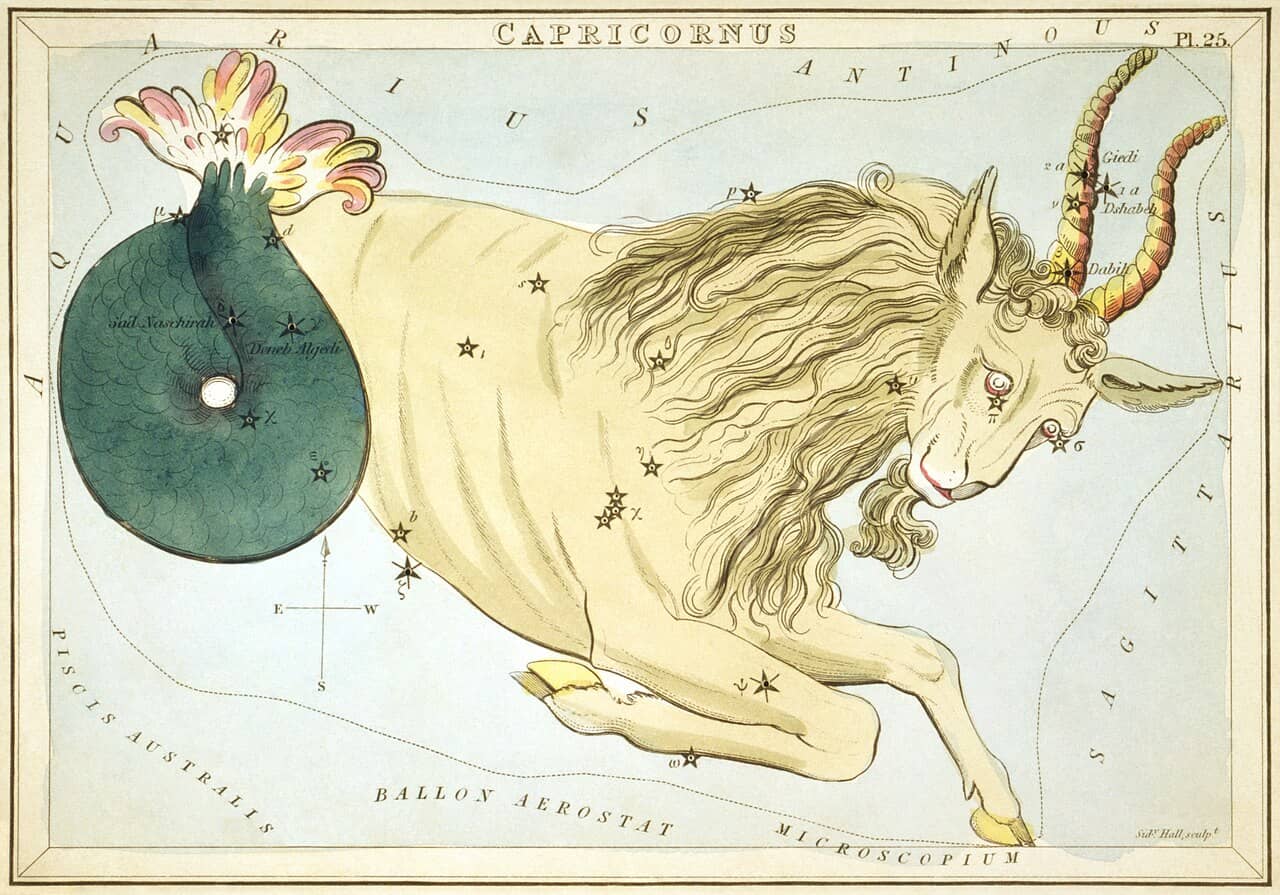
If you want the sign as it functions today, dates and modality and the Sun’s rulership and all, the department monograph on Leo in The Zodiac is the reference page, and the broader The Zodiac department collects the same source-first treatment for every sign. For a neighbouring case of a figure far older than its Greek myth, the essay on Capricorn’s dates, traits, and mythology follows the Babylonian goat-fish of the god Ea down the same long road from Mesopotamia to the modern star chart. The pattern repeats across the wheel: the horoscope is the shallow end, and the history is where the water gets deep.
On the sources: the Babylonian Great Lion (UR.GU.LA), its abbreviation UR/UR.A, its record in MUL.APIN, and Regulus as “the star that stands at the Lion’s breast” follow standard histories of the constellations and of Mesopotamian astronomy, with the early (fourth-millennium BCE) lion attribution and the third-millennium-BCE summer-solstice position in Leo restating well-established positional astronomy. The Nemean Lion as the first labour of Heracles, its variant parentage (Orthrus in Hesiod, Typhon in Apollodorus, the Selene/Moon tradition), the impervious hide, the strangling, the skinning with the lion’s own claw, the Molorchus episode, and the catasterism by Zeus follow the standard Greek mythographic tradition, preserved in the Eratosthenic Catasterismi and the Astronomica of Hyginus, with Ptolemy’s second-century Almagest as the classical star catalogue. The Egyptian Nile-flood association is flagged as disputed and treated as a popular gloss rather than documented Egyptian constellation lore.
⁂
ZOD Culture Editorial Team
Writes on zodiac & myth for ZOD Culture.
Comments
Comments are reviewed before publication. Plain text only; links are not allowed.
Loading comments…