Zodiac & Myth
Capricorn Dates, Traits, and Mythology
Capricorn runs December 22 to January 19, opening at the winter solstice. A guide to its dates, the Sumerian sea-goat, and the Tropic of Capricorn.
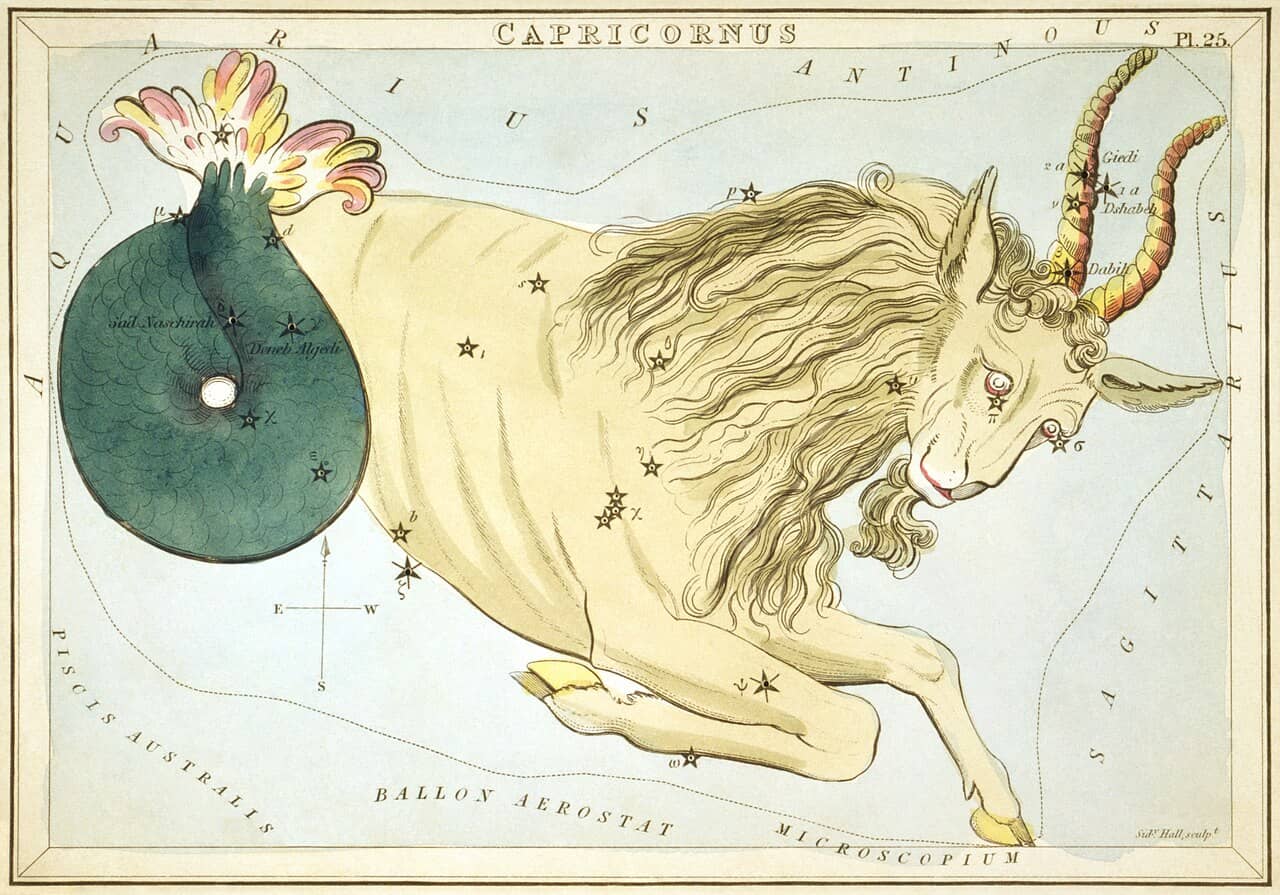
Capricorn is the tenth sign of the western zodiac, and in the standard tropical calendar the Sun occupies it from December 22 to January 19. Alone among the twelve signs, its start is not an arbitrary line on a chart: it opens at the winter solstice, the exact moment the Sun reaches its lowest point in the northern sky and the year turns back toward light. If your birthday sits near either edge, the boundary shifts by about a day from year to year, and our zodiac signs and dates finder will settle your sign from your birthdate. This page is the longer story: why the goat has a fish tail, why a line of latitude carries its name, and why that name is now, strictly speaking, out of date.
The dates, and why the solstice matters
The tropical zodiac divides the year, not the sky, into twelve equal thirty-degree arcs measured from the March equinox. Capricorn is the arc that begins at zero degrees from the December solstice and runs about thirty degrees onward, which lands it roughly from December 22 to January 19. Because the tropical year is about 365.25 days, the Sun reaches that solstice point at a slightly different clock time each year, so the crossing can slip about a day earlier or later depending on the year and your time zone.
This is what “born on the cusp” actually means, and it is worth stating plainly because the newspaper version is misleading. You are not half Sagittarius and half Capricorn. The Sun crosses the boundary at one exact instant, so you are born on one side of it. The blended-cusp idea is a twentieth-century syndication convention, invented when columns needed to route every reader to a single paragraph rather than print exact ephemeris times. If you were born on or near December 22 or January 19, the only way to be certain is to check the Sun’s position for your precise date, time, and place. Our signs and dates finder flags these boundary birthdays for that reason.
What makes Capricorn’s opening date unusual is that it is anchored to a real astronomical event rather than a convention. The solstice is the same moment that has organised midwinter festivals across the northern hemisphere for millennia, from the Roman Saturnalia to the observances that later gathered around late December. Capricorn is, quite literally, the sign of the turning year.
The oldest sea-goat: Sumer and Babylon before Greece
Most Capricorn pages open with a Greek god. That is starting the story several thousand years too late. The goat-fish is one of the oldest identifiable figures in the entire zodiac, and it is Mesopotamian, not Greek.
On the Babylonian star lists the constellation is SUHUR.MASH, the goat-fish, and the hybrid image is older still, reaching back through Sumerian tradition to the Middle Bronze Age. It was associated with Ea, the Babylonian form of the Sumerian Enki, the god of fresh water, wisdom, and craft, who was imagined dwelling in the freshwater deep beneath the earth. A creature that is goat above and fish below is a precise emblem for a water-god’s domain: at home on the mountain pasture and in the abyss at once. The figure appears carved on kudurru, the Babylonian boundary stones that recorded land grants under divine protection, centuries before any Greek writer described it. When Ptolemy catalogued the constellations in the second-century Almagest, the goat-fish was already ancient.
The Greeks inherited the figure and, as they usually did, fitted it to their own stories. The commonest tale makes it Pan, or the goat-god Aegipan, caught up in the gods’ war against the monster Typhon. Fleeing along the Nile, Pan leapt into the river and tried to turn himself into a fish; the transformation caught only his lower half, leaving him goat above the water and fish below, and Zeus set the odd result among the stars. It is a neat Greek explanation, but it is an explanation grafted onto a Mesopotamian image that already existed. The fish tail was not invented by the Pan story. The Pan story was invented to account for a fish tail the Greeks had received from older sky-watchers.
Amalthea, and a piece of honest untangling
A second Greek figure is often bundled into Capricorn, and it is worth separating out rather than blurring together. Amalthea is the goat, or in some versions the goat-nymph, who suckled the infant Zeus in a Cretan cave while he was hidden from his father Cronus. One of her horns, broken off, became the cornucopia, the horn of plenty. It is a lovely myth and it is genuinely about a goat, but it is not really the myth of the sea-goat. Amalthea has no fish tail and is more often attached in the old sources to the bright star Capella, the “she-goat” of the constellation Auriga, than to Capricornus.
Many popular pages merge Amalthea and the sea-goat into one story because both involve goats and Zeus. The honest version keeps them apart: Capricorn is the goat-fish of Ea, later read as Pan escaping Typhon, while Amalthea is a separate nurturing-goat tradition that drifted into the sign’s orbit by association. Both are worth knowing. Only one of them explains the tail.
The star names, and the faintest sign in the zodiac
Capricorn is easy to miss in the sky. It is the smallest constellation of the zodiac and one of the faintest, a shallow triangle of dim stars with only a single one brighter than third magnitude. Yet its star names preserve the goat as clearly as Libra’s preserve the scorpion’s claws.
The brightest, Delta Capricorni, is Deneb Algedi, from the Arabic for “the tail of the goat.” Alpha Capricorni is Algedi, or Giedi, from al-jady, simply “the goat” or “the kid.” Beta Capricorni is Dabih. The Arabic names entered European star catalogues through the medieval transmission of Ptolemy and remain in use today, so that every clear night the goat is still labelled, star by star, in a thousand-year-old vocabulary.
The Tropic of Capricorn, and why the name is out of date
Here is the detail that most Capricorn pages never reach, and it is the sign’s best story. Look at any world map and you will find a line of latitude across the southern hemisphere marked the Tropic of Capricorn, mirrored by the Tropic of Cancer in the north. Those lines mark the farthest points, south and north, that the Sun stands directly overhead at noon, and they turn at the two solstices.
They are named for the signs the solstice Sun occupied when the geography was fixed in antiquity. Two thousand years ago the December solstice fell with the Sun in the constellation Capricornus, so the southern turning-line took the goat’s name. But the constellations have since drifted against the calendar. The slow wobble of Earth’s axis, called precession, moves the solstice and equinox points about one degree every seventy-two years, a full circuit in roughly twenty-six thousand years. Over two millennia that adds up to nearly a whole sign. The December solstice Sun has slid out of Capricornus and now sits in neighbouring Sagittarius, and the June solstice has likewise left Cancer for Taurus.
So the two most famous lines on the globe are named for a piece of sky the Sun no longer visits at the solstice. Geographers kept the old names, and there is no reason to change them, but they are a permanent, printed reminder that the signs and the constellations are two different things that long ago came apart. The tropical zodiac, the one western astrology uses, stays tied to the solstices and equinoxes themselves, which is why tropical Capricorn still begins at the December solstice no matter where the stars have wandered.
Saturn, and the gate of the gods
In traditional astrology Capricorn is ruled by Saturn, the same slow outer planet that rules Aquarius, and it is classed as a cardinal earth sign. “Cardinal” places it with Aries, Cancer, and Libra, the signs that open each season, which fits a sign that begins at a solstice; “earth” groups it with Taurus and Virgo, the signs traditionally linked to the practical and the material. The stock adjectives that trail Capricorn around, disciplined, ambitious, patient, reserved, dryly funny, are the long-settled literary associations of that cardinal-earth, Saturn-ruled position, refined over centuries of astrological writing rather than measured from anyone’s birthday.
There is also a stranger and older thread worth knowing. In late-antique Neoplatonic thought, writers such as Porphyry in his essay on the Cave of the Nymphs, and Macrobius in his commentary on the Dream of Scipio, described two celestial “gates” where the zodiac crosses the band of the Milky Way. Cancer was the gate of men, through which souls were said to descend into birth; Capricorn was the gate of the gods, through which they ascended and returned. It is a symbolic scheme, not astronomy, but it shows the sign carrying a weight of meaning, thresholds, ascent, the turn from dark to light, that fits the solstice far better than any modern personality checklist.
It is worth being clear about what all of this is and is not. These traits and traditions are a cultural inheritance, a shared vocabulary for thinking about temperament, in the same family as the four humours or a novelist’s shorthand. They are not a diagnosis, a forecast, or a set of instructions, and nothing about a birth date determines health, wealth, or destiny. Read them as an old and expressive symbolic language: a lens, not a law.
So, are you a Capricorn?
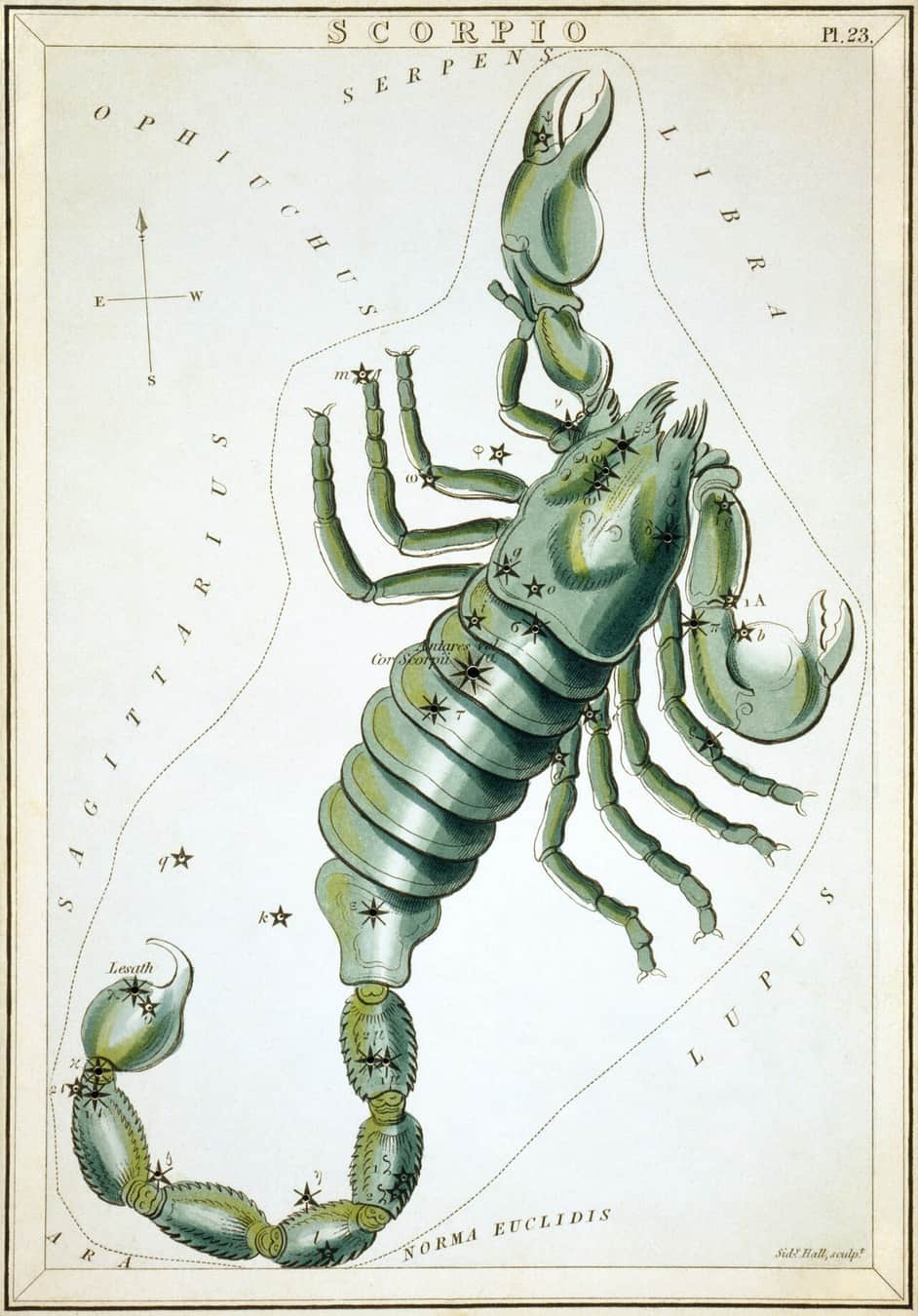
If your birthday falls cleanly between December 22 and January 19, yes, by the standard tropical convention. If it sits on the edge, near December 22 or January 19, the honest answer is that it depends on the exact year and time zone, and you should check the Sun’s precise position rather than trust a fixed calendar date. Start with our zodiac signs and dates finder, which lists every sign’s range and flags the boundary days where the crossing shifts. If you landed here from the other end of autumn, the companion piece on Scorpio’s dates, traits, and mythology traces a similar path from Babylon to the modern sky. And to see how Capricorn pairs with another sign, our zodiac compatibility checker reads any two signs by element, modality, and aspect, and shows its working rather than a hollow percentage.
Whatever you make of the astrology, the goat-fish is a genuine inheritance: a Sumerian and Babylonian emblem of a water-god, refitted by Greek myth as Pan escaping Typhon, tangled up with the nurse of Zeus, spelled out star by star in medieval Arabic, and stamped onto every world map as a line the Sun has quietly outgrown. That history is real, sourced, and older than any horoscope.
On the sources: the Babylonian goat-fish (SUHUR.MASH) and its link to the god Ea, together with the kudurru boundary stones, are documented in standard histories of the constellations and of Mesopotamian astronomy, with Ptolemy’s second-century Almagest as the classical catalogue. The Pan-and-Typhon and Amalthea myths follow the standard Greek mythographic tradition, with the Amalthea-Capella distinction noted in constellation references. The star names Deneb Algedi, Algedi, and Dabih, and Capricornus as the smallest and one of the faintest zodiac constellations, follow standard astronomy references. The Tropic of Capricorn point, and the movement of the solstice out of Capricornus through precession, restate well-established positional astronomy. The gate-of-the-gods scheme is drawn from Porphyry’s On the Cave of the Nymphs and Macrobius’s Commentary on the Dream of Scipio.
⁂
ZOD Culture Editorial Team
Writes on zodiac & myth for ZOD Culture.
Comments
Comments are reviewed before publication. Plain text only; links are not allowed.
Loading comments…