Zodiac & Myth
Scorpio Dates, Traits, and Mythology
Scorpio runs October 23 to November 21. A culturally literate guide to its dates, cusp drift, traditional traits, Babylonian myth, and Ophiuchus.
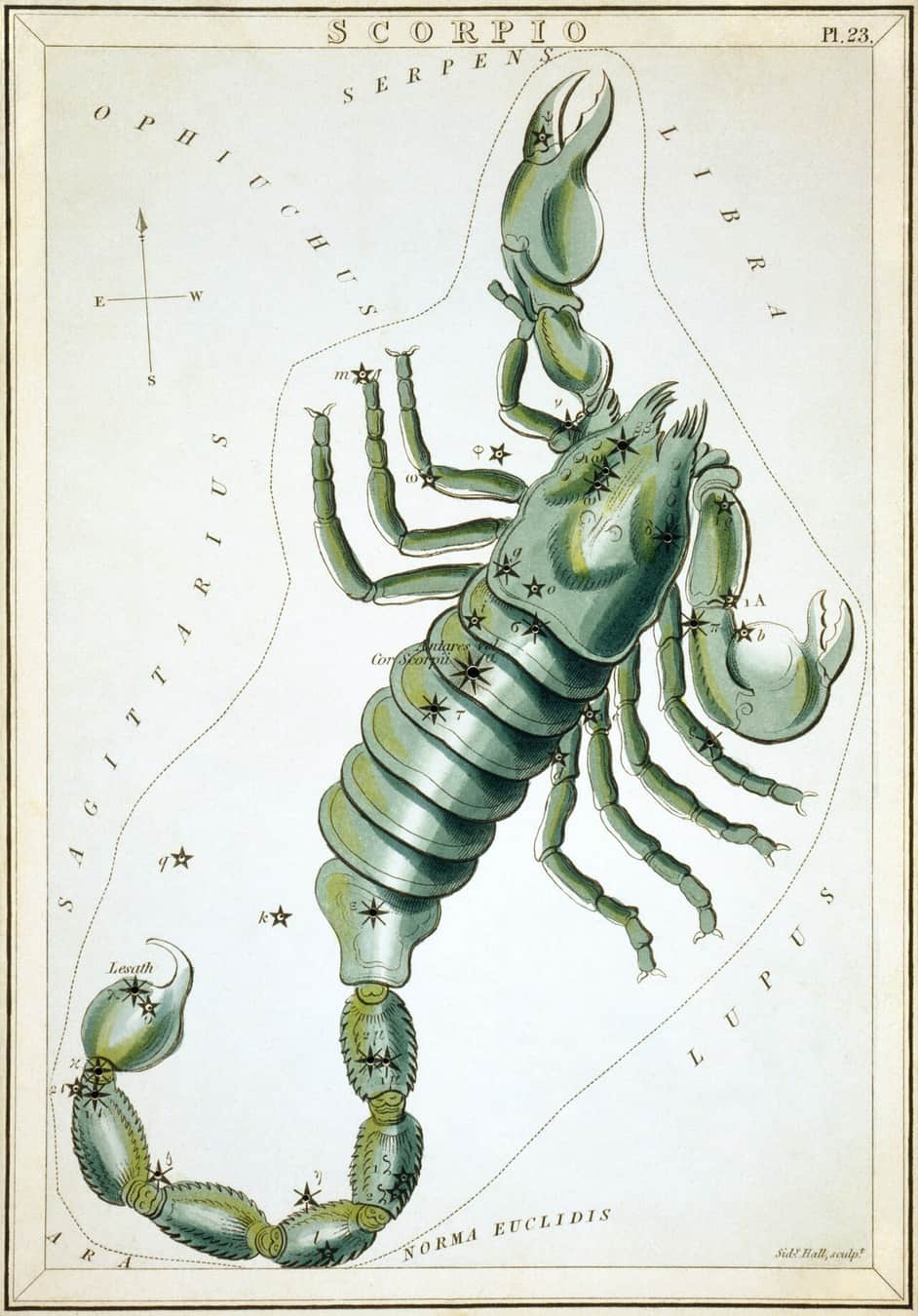
Scorpio is the eighth sign of the western zodiac, and in the standard tropical calendar the Sun occupies it from October 23 to November 21. If your birthday lands right on one of those edges, hold on: the boundary is not fixed to the calendar the way a horoscope column implies, and the reason is genuinely interesting. If you only want the quick answer, our zodiac signs and dates finder will settle your sign from your birthdate. This page is for the longer story: where the scorpion came from, why it once had claws, and why no space agency has ever taken your sign away.
The dates, and the honest part about cusps
The tropical zodiac divides the year, not the sky, into twelve equal thirty-degree arcs measured from the March equinox. Scorpio is the arc the Sun crosses roughly from October 23 to November 21. “Roughly” is the operative word. The tropical year is about 365.25 days, so the Sun reaches each sign boundary at a slightly different clock time every year, and the crossing can slip about a day earlier or later depending on the year and your time zone.
That is what “born on the cusp” actually means. It is not that you are half Libra and half Scorpio. The Sun crosses the Libra-to-Scorpio line at one exact instant, so you are born on one side of it. The blended-cusp idea is a twentieth-century newspaper convention, invented when syndicated columns needed to route every reader to a single paragraph rather than publish exact ephemeris times. If you were born on or near October 23 or November 21, the only way to be certain is to check the Sun’s position for your precise date, time, and place of birth. Our signs and dates finder flags these boundary birthdays for exactly this reason.
The oldest scorpion: Babylon to Greece to Rome
Scorpio is one of the genuinely ancient constellations. On the Babylonian star lists it is GIR.TAB, the scorpion, and it appears in the MUL.APIN compendium of celestial observations compiled in the early first millennium BCE, well before Greek astronomy inherited and renamed the sky. When Ptolemy catalogued the constellations in the second-century Almagest, the scorpion was already old news.
Greek myth attached the scorpion to the hunter Orion. In the most common version, Orion boasted that he could kill any creature on Earth, and a scorpion was sent to strike him down; both were set among the stars, where Scorpius still rises in the east as Orion sets in the west, so the hunter appears to flee his killer around the sky forever. It is a tidy piece of sky-storytelling: the two figures are on opposite sides of the celestial sphere and are almost never visible at the same time.
Here is the detail most Scorpio pages miss. The constellation was once much larger. The Greeks called its western half the Chelae, the Claws. In the first century BCE the Romans split those claws off into a separate figure and read them as a balance, giving us Libra, the only inanimate sign of the zodiac. The evidence is still fossilised in the star names: Libra’s two brightest stars are Zubenelgenubi and Zubenelschamali, Arabic for the Southern Claw and the Northern Claw. Libra is, quite literally, the amputated pincers of the scorpion.
At the scorpion’s heart sits one of the most striking stars in the sky. Antares (Alpha Scorpii) is a red supergiant so large that, dropped in place of our Sun, it would swallow the orbit of Mars. Its reddish color and its position near the ecliptic meant it was often mistaken for the planet Mars, and the Greek name Antares means “rival of Ares,” the war god the Romans called Mars. In ancient Persia it was counted among the four “royal stars” that watched over the seasons. Long before anyone wrote a personality profile, Scorpio was the arc of sky with a red star for a heart.
Mars, then Pluto: how Scorpio ended up with two rulers
In traditional astrology, from the Hellenistic period through the Renaissance, Scorpio was ruled by Mars, the same planet that governs Aries. That is the older and, in classical terms, the correct answer, and it fits the imagery of the war god’s rival star burning in the scorpion’s chest.
The “Pluto rules Scorpio” line is a modern addition. Pluto was only discovered in 1930, and twentieth-century astrologers assigned the newly found body to Scorpio, tying it to themes of depth and transformation. So when a contemporary source lists Scorpio’s ruler as Pluto, it is following a convention less than a century old, not an ancient one. Both are worth knowing: Mars is the traditional ruler, Pluto the modern one. Neither claim is astronomy; they are conventions within a symbolic system, and it is more honest to describe them that way than to present either as fact.
What “Scorpio traits” actually describe
By classical categories Scorpio is a fixed water sign. “Water” places it with Cancer and Pisces in the group traditionally linked to feeling and intuition; “fixed” places it with Taurus, Leo, and Aquarius, the signs that fall in the settled middle of each season rather than at its start or turn. The stock adjectives that follow Scorpio around, intense, private, loyal, strategic, hard to read, are the traditional literary associations of that fixed-water position, refined over centuries of astrological writing.
It is worth being clear about what that is and is not. These traits are a cultural tradition, a shared vocabulary people use to think about temperament, in the same family as the four humours or a novelist’s character shorthand. They are not a diagnosis, a forecast, or a set of instructions, and nothing about a birth date determines health, wealth, or destiny. Read them the way you would read any old and expressive symbolic language: as a lens, not a law.
The Ophiuchus question: did NASA add a 13th sign?
Every few years a headline claims that NASA “discovered” a thirteenth zodiac sign, Ophiuchus the serpent-bearer, and quietly shuffled everyone’s dates, with Scorpio taking the biggest hit. It is worth answering plainly, because it lands hardest on Scorpio.
NASA changed nothing. The agency does not practice astrology and has no standing to redraw it; what NASA actually did, in a 2016 educational post, was point out the long-known difference between constellations and signs. There really are thirteen constellations along the Sun’s yearly path, because Ophiuchus dips into the ecliptic, and the Sun genuinely passes in front of it for roughly three weeks each year, from about November 29 to December 17. The Babylonians simply chose twelve equal signs over thirteen unequal constellations some three thousand years ago, to match a twelve-month scheme.
Two facts dissolve the panic. First, western astrology uses the tropical zodiac, which is tied to the seasons and the equinox, not to the current position of the star patterns, so where Ophiuchus sits has no bearing on tropical Scorpio. Second, the constellations really have drifted relative to the signs, but this is old and expected: the slow wobble of Earth’s axis, called precession, moves the equinox point about one degree every seventy-two years, a full circuit every twenty-six thousand years or so. Since Ptolemy’s day the signs and the constellations have slid nearly a whole sign apart, which is why the Sun today spends only about a week in front of the actual stars of Scorpius, around late November, and rather longer crossing Ophiuchus next door. None of that moves the tropical sign. If you were a Scorpio last year, you are a Scorpio still.
So, are you a Scorpio?
If your birthday falls cleanly between October 23 and November 21, yes, by the standard tropical convention. If it sits on the edge, near October 23 or November 21, the honest answer is that it depends on the exact year and time zone, and you should check the Sun’s precise position rather than trust a fixed calendar date. Start with our zodiac signs and dates finder, which lists every sign’s range and flags the boundary days where the crossing shifts. Curious how Scorpio pairs with another sign? Our zodiac compatibility checker reads any two signs by element, modality, and aspect, and shows its working rather than a hollow percentage.
Whatever you make of the astrology, the scorpion is a genuine inheritance: a Babylonian figure, refigured by Greek myth, cut in half by Roman astronomers, and anchored by a red supergiant the ancients mistook for a planet. That history is real, sourced, and older than any horoscope.
On the sources: the Babylonian scorpion (GIR.TAB) and the MUL.APIN star lists, and Ptolemy’s second-century Almagest and Tetrabiblos, are the standard references for the constellation’s lineage; the Chelae-to-Libra split and the claw names Zubenelgenubi and Zubenelschamali are documented in constellation histories; Antares as a red supergiant, “rival of Ares,” and a Persian royal star follows standard astronomy references; and the Ophiuchus point restates NASA’s own 2016 explainer on constellations versus signs, together with the well-established mechanics of axial precession.
⁂
ZOD Culture Editorial Team
Writes on zodiac & myth for ZOD Culture.
Comments
Comments are reviewed before publication. Plain text only; links are not allowed.
Loading comments…