Zodiac & Myth
Leo Dates, Traits, and Mythology
Leo runs July 23 to August 22, at the height of summer. A guide to its dates, the Nemean Lion, and Regulus, the royal star at the heart of the constellation.
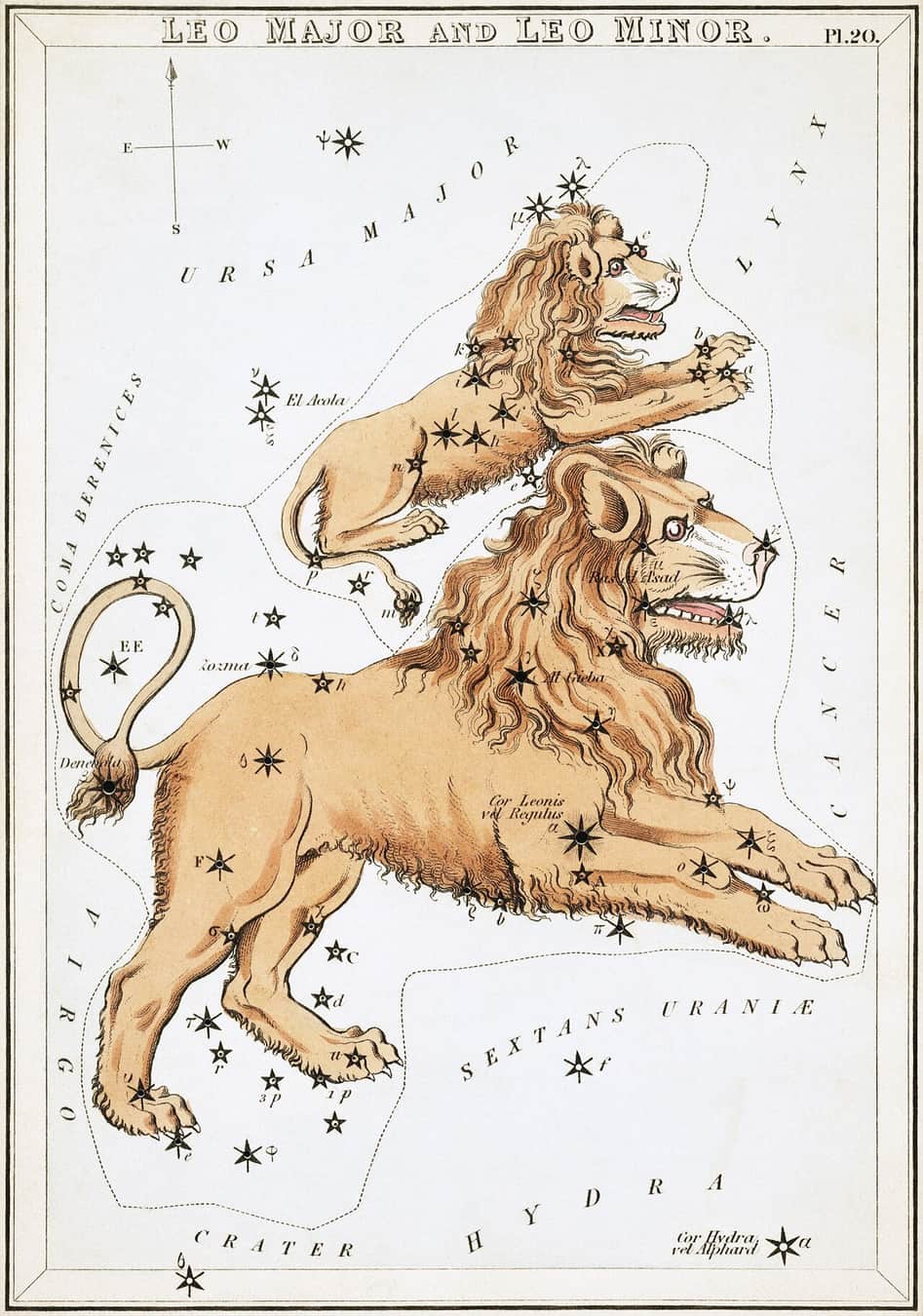
Leo is the fifth sign of the western zodiac, and in the standard tropical calendar the Sun occupies it from July 23 to August 22. It is a high-summer sign, the arc of the year when the Sun is at its most powerful in the northern sky, which is fitting for the only sign ruled by the Sun itself. If your birthday sits near either edge of that range, the boundary shifts by about a day from year to year, and our zodiac signs and dates finder will settle your sign from your exact birthdate. This page is the longer story: where the lion came from, why its brightest star was called a king for three thousand years, and why the constellation and the sign no longer sit in the same patch of sky.
The dates, and what “born on the cusp” really means
The tropical zodiac divides the year, not the visible sky, into twelve equal arcs of thirty degrees each, measured from the March equinox. Leo is the arc that runs from roughly one hundred and twenty degrees to one hundred and fifty degrees along that circle, which lands it from about July 23 to August 22. Because the tropical year is close to 365.25 days rather than a whole number, the Sun reaches each boundary at a slightly different clock time each year, so a crossing can slip about a day earlier or later depending on the year and your time zone.
This is what the newspaper phrase “born on the cusp” is groping at, and it is worth stating plainly because the popular version is misleading. If your birthday is July 22 or 23, you are not half Cancer and half Leo. The Sun crosses the boundary at one exact instant, so you fall on one side of it. The blended-cusp idea is a twentieth-century syndication convention, invented when columns needed to route every reader to a single paragraph rather than print exact ephemeris times. If you were born on or near July 23 or August 22, the only honest way to be sure is to check the Sun’s position for your precise date, time, and place. Our signs and dates finder flags these boundary birthdays for exactly that reason.
Before Greece: the lion of Babylon
Most Leo pages open with Heracles. That starts the story more than a thousand years too late. The lion is one of the oldest and most stable figures in the entire zodiac, and it reaches the Greeks already ancient.
On the Babylonian star lists the constellation is UR.GU.LA, “the Great Lion” or simply “the Lion,” and it appears in MUL.APIN, the compendium of Mesopotamian sky lore compiled well before the classical Greek astronomers. Unlike Aries, whose Babylonian name was the Hired Man before the Greeks made it a ram, Leo did not need translating. The Mesopotamians already saw a lion here, the Greeks saw a lion, and the figure passed down the centuries essentially unchanged. That continuity is unusual and worth noticing: the sky is full of images that were swapped in transmission, and the lion is one of the few that everyone agreed on.
The Nemean Lion, and a pelt worn as armour
The Greek story attached to the constellation is the first of the twelve labours of Heracles. The Nemean Lion was a beast whose golden hide no blade could pierce. Heracles emptied his quiver against it and the arrows glanced off; in the end he cornered the animal in its cave and strangled it with his bare hands. He then skinned it, using one of the lion’s own claws to cut the impervious hide, and wore the pelt as armour ever after, the lion’s head serving as a helmet. The gods set the lion among the stars, where it stands as the constellation Leo.
It is a good myth, and like most of the Greek zodiac it is an explanation grafted onto an image that already existed. The lion did not become a constellation because Heracles killed it. The Heracles story was fitted to a lion the Greeks had inherited from older sky-watchers, the same UR.GU.LA the Babylonians had been charting for a thousand years. What the myth adds is a piece of characteristic Greek meaning: invulnerability, raw strength, and the pelt of a defeated monster turned into a hero’s protection.
Regulus: the little king, and the heart of the lion
Leo’s best story is not a myth at all. It is a star. The brightest point in the constellation, Alpha Leonis, sits almost exactly on the ecliptic, the line the Sun, Moon, and planets trace across the sky, and it marks the position of the lion’s heart. The Romans called it Cor Leonis, “the heart of the lion,” a phrase the astronomer Copernicus helped fix in later star catalogues.
Its more famous name records something older. We call the star Regulus, Latin for “little king,” a diminutive of rex. That was not a Renaissance invention either. The Greeks knew it as Basiliskos, again “little king,” and behind the Greek stands a Mesopotamian tradition in which this star was tied to kingship and the fortunes of rulers. The name has meant “the king” or “the little king” in an unbroken line from Babylon through Greece and Rome to the modern almanac.
Regulus was also one of the four so-called royal stars of ancient Persian astronomy, the group later writers called the Watchers of the sky: Regulus in Leo, Aldebaran in Taurus, Antares in Scorpius, and Fomalhaut in the south. Several thousand years ago these four bright stars sat near the equinox and solstice points and were treated as guardians of the four quarters of the heavens. Precession has since carried the turning points away from all four, but the tradition survives in the stars’ names and reputations. When a Leo page tells you the sign is regal, this is the buried root of the claim: the constellation carries a star that the oldest astronomers of the Near East had already crowned.
The constellation and the sign have come apart
Here is the detail that horoscope pages almost never reach. The dates above, July 23 to August 22, are the dates of the tropical sign of Leo, not of the constellation Leo. The two are no longer the same stretch of sky.
The slow wobble of Earth’s axis, called precession, moves the equinox and solstice points about one degree every seventy-two years, a full circuit in roughly twenty-six thousand years. When the zodiac was fixed in antiquity, sign and constellation lined up closely. Over the two thousand years since, they have drifted nearly a whole sign apart. Today the Sun actually passes in front of the stars of the constellation Leo from about the middle of August into September, weeks after the astrological sign of Leo has begun. Tropical astrology, the system western horoscopes use, deliberately stays tied to the seasons rather than the stars, which is why the sign of Leo still opens in late July no matter where the constellation has wandered. The sign and the constellation share a name and a lion, but they are two different things that long ago parted company.
The Sun, fixed fire, and the traits
In traditional astrology Leo is the domicile of the Sun, the only sign a luminary rules alone, and it is classed as a fixed fire sign. “Fire” groups it with Aries and Sagittarius, the signs associated with warmth, drive, and outward energy. “Fixed” places it with Taurus, Scorpio, and Aquarius, the signs that sit in the settled middle of each season rather than opening or closing it, and that carry a reputation for steadiness and stubbornness in equal measure. The stock adjectives that follow Leo around, confident, generous, proud, loyal, hungry for the spotlight, are the long-settled literary associations of that fixed-fire, Sun-ruled position, refined over centuries of astrological writing rather than measured from anyone’s birthday.
It is worth being clear about what this is and is not. These traits are a cultural inheritance, a shared vocabulary for talking about temperament, in the same family as the four humours or a novelist’s shorthand. They are not a diagnosis, a forecast, or a set of instructions, and nothing about a birth date determines health, wealth, or destiny. Read the Leo character sketch as an old and expressive symbolic language: a lens, not a law.
Who does Leo get along with?
The conventional answer follows straight from the elements. Astrology’s oldest compatibility logic pairs a fire sign most easily with the other fire signs and with the air signs, since air feeds fire. That puts fellow fire signs Aries and Sagittarius at the top of the usual Leo list, with the air signs Gemini and Libra close behind, and it flags the other fixed signs, especially Aquarius directly across the zodiac, as the classic study in attraction and friction. None of this is destiny. It is a symbolic grammar of elements and modalities, and it is more interesting when you can see the reasoning than when it is boiled down to a percentage. Our zodiac compatibility checker reads any two signs by element, modality, and aspect, and shows its working rather than handing you a hollow score.
So, are you a Leo?
If your birthday falls cleanly between July 23 and August 22, yes, by the standard tropical convention. If it sits on the edge, near July 23 or August 22, the honest answer is that it depends on the exact year and time zone, and you should check the Sun’s precise position rather than trust a fixed calendar date. Start with our zodiac signs and dates finder, which lists every sign’s range and flags the boundary days where the crossing shifts. For the full picture of the lion in myth, history, and the sky, see the department monograph on Leo in The Zodiac. And if you arrived here from the cold end of the year, the companion pieces on Capricorn’s dates, traits, and mythology and Scorpio’s dates, traits, and mythology trace the same path from Babylon to the modern sky.
Whatever you make of the astrology, the lion is a genuine inheritance: a Babylonian constellation that needed no translation, refitted by Greek myth as the beast Heracles strangled and skinned, crowned at its heart by a star the oldest astronomers called the king, and stranded by precession weeks away from the calendar dates that still carry its name. That history is real, sourced, and older than any horoscope.
On the sources: the Babylonian lion (UR.GU.LA) and its record in MUL.APIN, together with the Nemean Lion as the first labour of Heracles, follow the standard histories of the constellations and the Greek mythographic tradition, with Ptolemy’s second-century Almagest as the classical star catalogue. Regulus as Alpha Leonis, its position on the ecliptic, the names Cor Leonis, Basiliskos, and Regulus (“little king”), and its place among the four royal stars of ancient Persia restate well-established positional astronomy and the history of star names. The drift of the sign away from the constellation through precession, and the Sun’s present transit of the constellation Leo in mid-August into September, restate standard positional astronomy. The element and modality associations follow the settled Hellenistic and later astrological tradition.
⁂
ZOD Culture Editorial Team
Writes on zodiac & myth for ZOD Culture.

Comments
Comments are reviewed before publication. Plain text only; links are not allowed.
Loading comments…